Jackpot Jill Payment Methods Australia: Deposits, AUD and Banking
 Available in AU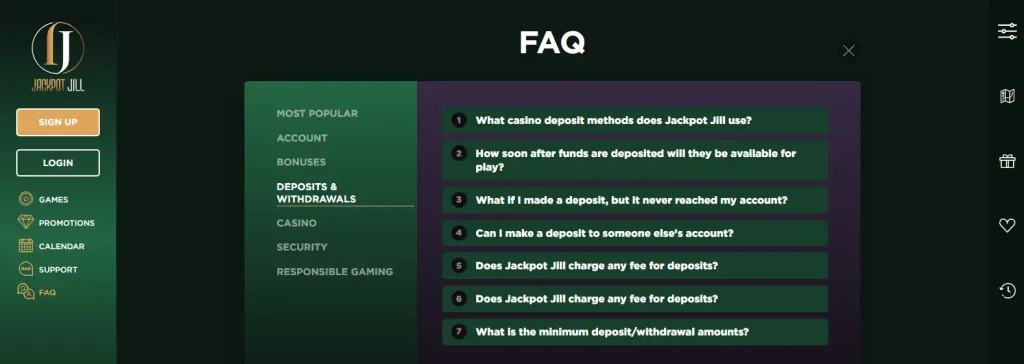
Deposits and account currency
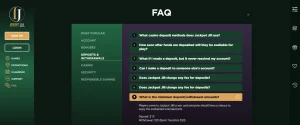
Jackpot Jill supports AUD as an account currency and currently shows several verified deposit routes: Visa and Mastercard, bank transfer, Neosurf, eZeeWallet, CashtoCode and cryptocurrency through PayWithCrypto, including Bitcoin, Bitcoin Cash, Ethereum, Litecoin and Dogecoin. The official FAQ lists a general minimum deposit of $10 and says Jackpot Jill does not charge deposit fees. That $10 line uses a generic dollar sign, so it should not be silently rewritten as an A$10 promise without the live cashier confirming the denomination. PayID is widely used in Australia, but current Jackpot Jill sources do not verify PayID support. Australian payment habits are useful context, not proof that a method appears in this casino’s cashier.
Which Jackpot Jill deposit methods are currently listed?
The strongest current evidence comes from Jackpot Jill’s own public pages. The homepage names Visa, Mastercard and bank transfer among its transaction methods. The mobile casino banking section adds Visa or debit card, Neosurf voucher, eZeeWallet, CashtoCode and PayWithCrypto. The same section lists Bitcoin, Bitcoin Cash, Ethereum, Litecoin and Dogecoin as supported crypto assets.
That gives Australian readers a concrete list without turning the page into a permanent cashier catalogue. Payment menus can vary by account, currency, device or provider availability, so the live deposit screen remains the final check for what your account can actually select. This page does not claim every listed deposit route is also available for withdrawal.
The distinction matters because deposit support and withdrawal support are not symmetrical by default. A method can be useful for funding an account without being the route used to return funds. For cash-out questions, use the dedicated withdrawal guide rather than inferring payout options from this deposit list.
AUD support is listed, but the $10 minimum needs careful wording
Jackpot Jill’s current FAQ lists EUR, CAD, AUD and NZD as supported currencies. That directly supports the statement that AUD is available as an account or player currency. It is more precise than saying the casino is simply “Australian”, because currency support is a cashier fact, not a licensing or legal-status claim.
The same FAQ separately lists “Deposit: $10” as the general minimum. The line does not print an ISO currency code beside the amount. For that reason, the accurate wording is that the official FAQ lists a $10 general minimum deposit. It would be an unnecessary leap to relabel the figure A$10 in this guide when the source itself does not do so.
Bonus-specific deposits can also have different qualifying amounts. If you are funding the account to activate a promotion, check the Jackpot Jill bonus separately instead of assuming the ordinary cashier minimum automatically qualifies for an offer.
Jackpot Jill says it does not charge deposit fees
The official FAQ states that Jackpot Jill does not charge fees for making deposits. That is a useful account-level fact, but it is narrower than saying a transaction can never cost anything. A bank, card issuer, wallet provider, currency converter or crypto network can apply its own charges outside the casino’s fee policy.
This guide therefore avoids publishing method-by-method fee tables unless a current official cashier or payment page verifies them. It also avoids calling all deposits “instant” or naming a fastest method. Those claims can become wrong when a provider, account review or banking route changes.
If a specific fee or timing matters before you transfer money, the most reliable sequence is to open the current deposit screen, select the method and inspect the amount and any displayed charge before confirming. That keeps a live transaction decision tied to live information rather than a static review.
Australian payment habits do not prove casino cashier support
The Reserve Bank of Australia’s 2025 Consumer Payments Survey gives useful background on how Australians pay in everyday life. Cards remained the most widely used consumer payment method, accounting for about 73% of payments, with debit cards making up about half. Online payments represented about 20% of consumer payments, and mobile or app initiated transactions made up 46% of online payments.
PayID also became much more familiar: around 80% of respondents knew about it and around 50% had used it in the previous year. Cryptocurrency had high awareness but low use as a payment method, with only about 2% reporting a crypto payment in the prior year.
| Australian payment context | What it means for this review |
|---|---|
| Cards are the dominant consumer payment method | It is unsurprising that Jackpot Jill lists card support, but RBA data does not prove casino-specific acceptance. |
| PayID awareness and use are high | Popularity in Australia does not establish PayID as a Jackpot Jill method. |
| Crypto payment use remains niche | Low mainstream use does not contradict Jackpot Jill’s verified crypto deposit options. |
This two-layer approach prevents a common review error: taking a popular Australian payment method and presenting it as if the casino must support it. Brand support needs brand-level evidence.
Why PayID is deliberately not on the Jackpot Jill method list
PayID is now a mainstream account-to-account payment service in Australia, so it is an obvious term to search when comparing casino banking. The current Jackpot Jill pages checked for this guide list cards, bank transfer, eZeeWallet, Neosurf, CashtoCode and crypto, but they do not verify PayID.
That absence does not prove PayID can never appear in an individual cashier. It means there is no allowed factual basis here to advertise it as supported. If PayID appears after login, the live cashier can establish that for your account. Until then, the review keeps Australian market popularity and Jackpot Jill support as separate facts.
The same discipline applies to any local payment label. A method should enter the public list only after the casino or another allowed source verifies it, not because the method is common in the target market.
Deposits, withdrawals and verification are separate account steps
Funding an account is only one part of the banking flow. Jackpot Jill’s current FAQ also requires account verification, and withdrawals have their own minimums and method considerations. That is why this page does not treat a successful deposit as proof that a later withdrawal will use the same route.
Before a cash-out, review the Jackpot Jill verification and confirm the withdrawal choices shown in the cashier. If you are still setting up the profile, the account setup explains the broader account path. Keeping those topics separate makes it easier to see which facts belong to deposits, which belong to identity checks and which belong to withdrawals.
That separation is especially important for method-specific processing times and withdrawal fees. This review does not publish those values because current official evidence does not establish a stable Australia-specific table for them.
Banking convenience does not establish Australian licensing status
AUD support, card support and familiar payment options describe the cashier. They do not establish that Jackpot Jill holds an Australian gambling licence or that a payment method has regulatory approval for online casino gambling. Those are different questions with different evidence standards.
For the regulatory side, use the Jackpot Jill licence in Australia. The purpose of the banking page is narrower: identify payment facts that are actually verified, make clear where live account checks are still necessary, and avoid using payment convenience as a substitute for legal or licensing analysis.
How to compare deposit routes without inventing a winner
The current list covers several different payment types, and each solves a different practical problem. Cards are familiar to many Australian consumers, bank transfer is a direct account-to-account route, Neosurf and CashtoCode are voucher or cash-code style options, eZeeWallet is a digital wallet, and PayWithCrypto provides access to the supported digital currencies. Those categories are verified, but the evidence does not support ranking them by speed, acceptance rate or total cost for every account.
A useful comparison therefore starts with what the live cashier actually offers after login. Check whether the method is available in your selected account currency, whether the amount you want to deposit sits within the displayed limits, and whether the payment provider shows any charge before confirmation. If you are using crypto, also check the asset and network details in the live payment flow rather than assuming one coin or chain works the same way as another.
For cards, the RBA data explains why card payment feels familiar in Australia, but that broad consumer pattern does not guarantee a particular issuer will approve an online gambling transaction. This guide makes no bank-by-bank acceptance claim. For vouchers and wallets, the same principle applies: listing a method at brand level does not prove it is offered to every individual account at every moment.
The best choice is therefore not a universal ranking. It is the verified method that is actually available to your account and whose live amount, currency and provider terms you have checked before confirming the deposit.
What to record before making a deposit
If you want a cleaner record of a transaction, note the method selected, the amount entered, the account currency and any fee or conversion message shown before confirmation. Keep the transaction reference or provider receipt once the payment is submitted. This is practical record-keeping rather than a claim that every payment will encounter a problem.
It also helps keep bonus and banking decisions separate. If a deposit is intended to trigger the welcome offer, check the promotion terms first, then record the deposit details. If it is an ordinary balance deposit, the standard cashier information is the relevant layer. That small distinction can prevent a general $10 cashier minimum from being mistaken for a bonus-qualifying threshold.
How Jackpot Jill banking works when your account is in AUD
For an Australian reader, the practical picture is straightforward. Jackpot Jill verifies AUD as a supported currency, currently lists cards, bank transfer, Neosurf, eZeeWallet, CashtoCode and several cryptocurrencies for deposits, and states a general $10 minimum deposit with no deposit fee charged by the casino. The live cashier should still be checked before funding because method availability can be account-specific, and the generic dollar amount should not be silently converted into an A$ figure. The Jackpot Jill Australia review connects these banking facts with games, bonuses, account access and regulatory context without treating one category as proof of another.